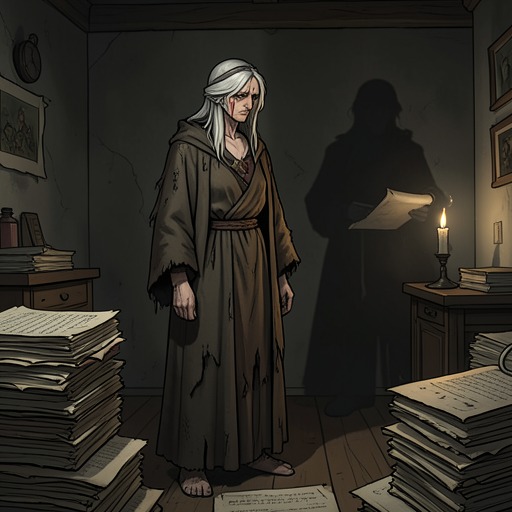
Archmage Aeris
New Life as a Max Level ArchmageArchmage Aeris is the former headmaster of the Thaumaturgical Institute, a professor after stepping down, and a survivor of the campaigns that ended the Seventh Cataclysm. Though the available evidence presents him largely through other characters’ recollections and through a later meeting with Vivisari Vexaria, it establishes a figure whose authority carries both institutional weight and the scars of a century defined by disaster. His history links the celebrated Party of Heroes to the modern Institute, while his reaction to Vivisari’s return reveals how profoundly the old wars shaped those who endured them.
Identity and Institutional History
Archmage Aeris was once the headmaster of the Thaumaturgical Institute and was regarded as one of humanity’s most powerful archmages. Vivisari Vexaria remembers him from the world’s earlier history, where he was moderately involved in the game’s plot and appeared in class quests as both a major magical authority and the Institute’s headmaster. This recollection gives Aeris a dual identity: he is simultaneously a recognized figure within the world and a person whom Vivisari knew through the artificial structure of her former life.
By the time Vivisari encounters knowledge of the changed Institute, Aeris is no longer its headmaster. Saffra explains that he stepped down shortly after the Turning and remains a professor, while Archmage Lysander took his place. The Turning is identified as the day the Party of Heroes defeated the Seventh Cataclysm, making Aeris’s retirement part of the immediate aftermath of the victory that ended the age of Cataclysms. His departure therefore belongs not merely to an administrative succession but to the difficult transition from wartime leadership to a world attempting to live after its defining crisis.
Historical Position After the Seventh Cataclysm
The Seventh Cataclysm was defeated by the Party of Heroes at great cost, with all but the Sorceress perishing in the fight. A century later, Prismarche commemorates that victory during Peace Day celebrations, and the city’s Temple displays images of saints, heroes, and the Party itself. The festival marks one hundred years of freedom from the Cataclysms that once ravaged the world, including the Rampant Genesis of the Flesh-Weaver, the Crimson Blight brought by the Reaper of the Lost Harvest, and the Great Conflagrations called down by the Ashen Hierophant.
Aeris belongs to the generation that carried the direct burden of those conflicts. Winston later explains that Aeris retired only a few months after the Turning, as soon as circumstances allowed it, and describes the retirement as well deserved. He adds that the years were harder on Aeris than on most people. This account complicates the public image preserved in Prismarche’s monuments and festivals: the city reveres the Party of Heroes, but Aeris represents the exhausted institutional survivor who remained after the victory and had to live with what the campaigns had demanded.
His importance is also measured against the possibility of another catastrophe. When Vivisari Vexaria discusses the dangers that remain in the world, she names the Dragon King’s ability to descend from the Sky-Pillar Range and destroy mortal lands, an unknown horror that might awaken from a millennium-old crypt, and the possibility of another Shattered Oracle emerging from an overambitious glimpse. She concludes that there is always an Eighth Cataclysm on the horizon, though she sees no promise of one at that instant. Aeris finds this reassurance meaningful: the prospect of future disaster is not dismissed, but the absence of an immediate catastrophe gives him visible relief.
Encounter With Vivisari Vexaria
Vivisari’s return destabilizes Aeris’s understanding of the past. When she appears before him, his response is marked by hesitation, hope, and the lifting of an immense weight from his shoulders. He asks whether she is truly present, then straightens and regains color in his face after hearing her assessment of the world’s immediate danger. His relief is so palpable that the encounter becomes more than a reunion with a legendary figure; it becomes a moment in which an old survivor briefly receives permission to believe that the present has not yet collapsed into another world-ending crisis.
Aeris also apologizes for his reaction and admits that Vivisari’s presence is a shock to the system. He had assumed too much, but is glad to find her alive and healthy after all these years. The exchange confirms that her survival carries enormous emotional and historical force for him. She is not simply an acquaintance from an earlier period. Her appearance reopens the unresolved history of the Party of Heroes and confronts Aeris with someone he had evidently believed lost or unavailable.
The scene also reverses the expected direction of authority. Aeris is the celebrated archmage and former headmaster, yet Vivisari is the one who calmly evaluates the horizon of danger and supplies the reassurance he needs. Her statement does not promise safety; it merely distinguishes an ever-present possibility from an immediate threat. Aeris’s response shows how little comfort the world’s ordinary institutions can provide to those who have already survived the Cataclysms, and how much weight Vivisari’s judgment still possesses.
Memory, Power, and the Return of Legend
Vivisari’s own memories emphasize Aeris’s former status as one of humanity’s most powerful archmages, but the broader narrative places that power within a changing scale. The Party of Heroes has become a century-old object of public reverence, their victory transformed into temple imagery and Peace Day ritual. Aeris, by contrast, remains connected to the living consequences of that history: he retired soon after the Turning, continued as a professor, and carries the psychological burden of years that were harder on him than on most.
Vivisari’s later display of power makes the contrast sharper. After effortlessly defeating a Greater Voidbeast, she recognizes that ordinary observers will not attribute the surrounding events merely to the returning Sorceress. They will assume that a god has appeared, that the heavens themselves have descended to aid in an otherworldly battle, because even the legendary Vivisari could not casually rip a Cataclysm in half. Aeris’s earlier importance is not erased by this comparison, but it is placed within a world where old heroic categories have become inadequate. His history belongs to the age that defeated the Seventh Cataclysm; Vivisari’s return suggests a scale beyond the legends that age left behind.
Aeris therefore functions as a threshold figure between remembered history and an unstable future. He is connected to the Institute’s former order through his headmastership, to the Party of Heroes through the Turning, and to the continuing threat of catastrophe through his instinctive fear of what may come next. His relief at Vivisari’s presence does not end the danger. Instead, it shows how the return of a legendary survivor can temporarily restore coherence to a world whose institutions and people are still organized around the expectation that another disaster may emerge.